

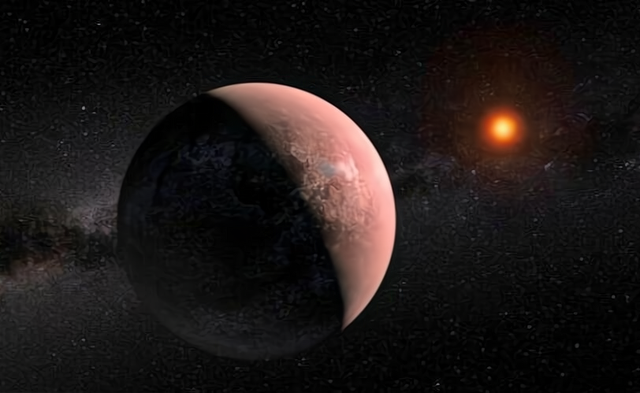
The sun is only one of an endless number of stars in the vast universe, and ever since this knowledge was gained, people have been speculating that other stars in the universe have their own planets, just like the sun.
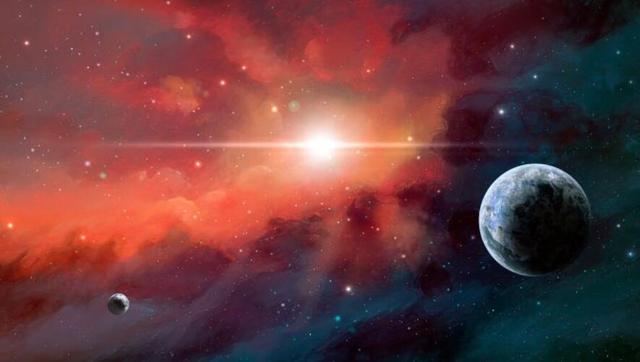
Although this makes sense, because the planets themselves do not emit light and are very small in mass and volume (relative to the stars), it was impossible to test this speculation for a long time.
It was only in 1995 that astronomers discovered the first exoplanet orbiting a main-sequence star, 51b pegasus, and since then the search for exoplanets has become a popular area of astronomy, and to date astronomers have discovered and to date, astronomers have discovered and confirmed more than 4,000 exoplanets, including some rocky planets larger than earth in size and mass, also known as 'super-earths'.
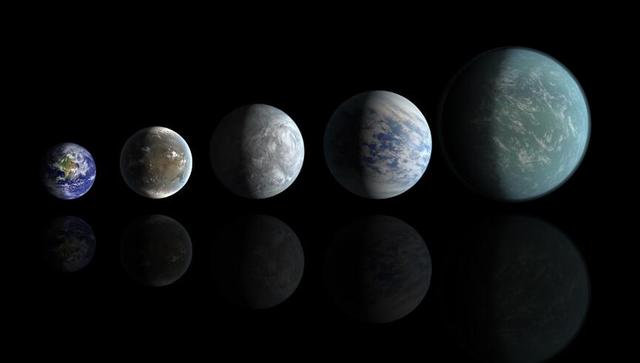
Recently, a team of astronomers published a paper claiming to have discovered another "Super-earth" Just 36.5 light-years from earth, which the astronomers named "Ross 508 b".
"Ross 508 b orbits a star named ross 508, a red dwarf of spectral type m4.5 in the constellation serpens, with a mass of about 18 per cent of the sun, a radius of about 21% and an effective temperature of about 3071 k (kelvin).
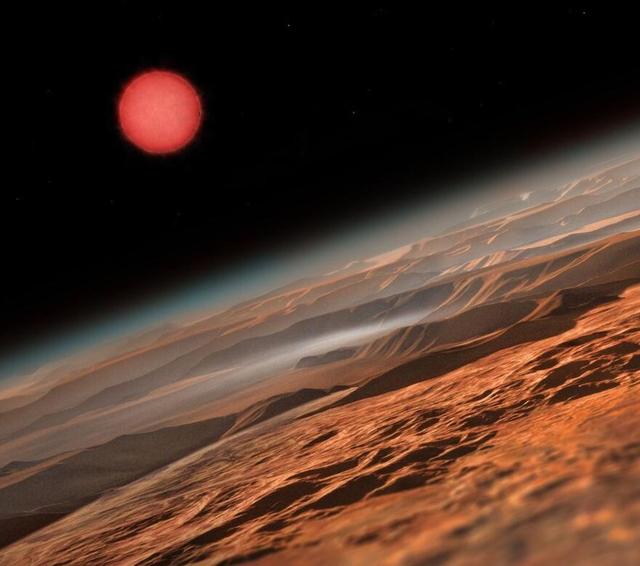
(imaginary image)
Observations show that "Ross 508 b" Is about four times as massive as the earth, orbits at an average distance of 0.053 astronomical units from its host star (equivalent to 5.3% of the solar-terrestrial distance), and revolves around its host star about once every 10.75 days.
Since "Ross 508" Is a faint red dwarf, its habitable zone is more inner than that of the sun, so this distance places "Ross 508 b" Just inside the habitable zone of its host star, in which case in this case, the surface temperature of "Ross 508 b" Would allow for the presence of liquid water, which would mean that there might be alien life on this "Super-earth".
It is important to note that this is an unproven hypothesis for the time being, and even if there is extraterrestrial life on ross 508 b, they would have a much harder time than life on earth, for two main reasons.
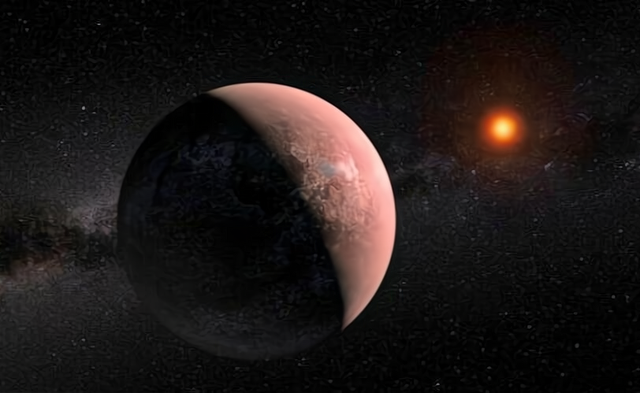
The first reason is that because "Ross 508 b" Is so close to its host star, it is likely to be tidally locked, which would result in "Ross 508 b" Having to face its host star on the same side all the time, in which case its "Sunward side would be constantly baked by the main star and its surface temperature would be very high, while the "Sunward side" Would be a "Dark world" With a low temperature because it would not be illuminated by the main star. If this is the case, then the "Back side" Will be a "Dark world" With low temperatures because it cannot be illuminated by the main star.
If this is the case, then the natural environment on both the "Sunny side" And "Back side" Of ross 508 b is very inhospitable to life, and only on the "Sunny side" And only in the narrow area where the "Sunny" And "Sunny" Sides meet could conditions suitable for life exist.
Another reason is that red dwarfs are much more "Temperamental" Than yellow dwarfs like the sun, where huge flares often appear on the surface.
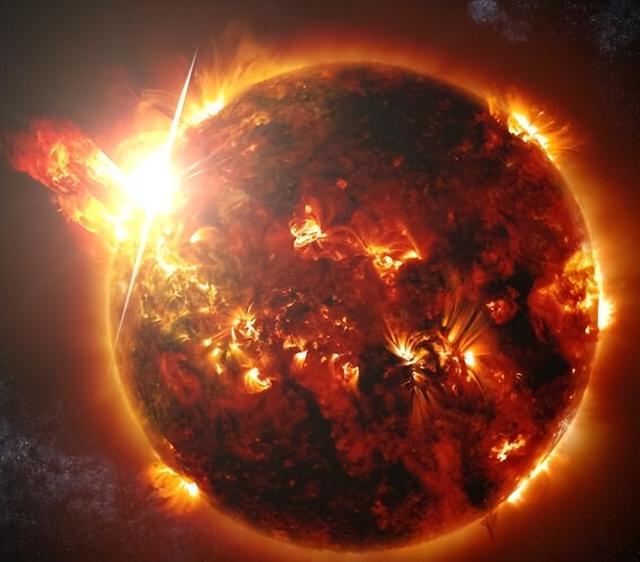
This is because the relatively small mass of red dwarfs prevents the formation of a 'radiation layer' like that of the sun, which prevents the outer layers from entering the core, resulting in direct convection between the outer layers of the red dwarf and the core, making the surface very unstable.
When a red dwarf flares on its surface, it releases much higher energy than usual through electromagnetic radiation (mainly in the x-ray, ultraviolet and radio wavelengths).
Proxima is a red dwarf star slightly smaller than ross 508, and in the past, astronomers have often observed huge flares on proxima, especially in may 2019, when a surprising super-flare occurred, which increased its brightness in the ultraviolet band by a factor of about 14,000 in just 7 seconds. 14,000 times the size of this super-flare, compared to the largest solar flare known to man, which was only about 1% of this super-flare.

"Ross 508 b is only 0.053 astronomical units away from its host star, so it is easy to imagine that if there is extraterrestrial life on this 'super-earth', it is likely to be simple creatures living underground or deep in the oceans. Life (at least as we know it) would be very unlikely to survive and thrive for long on the surface of a planet that is occasionally 'hit' by flare events at close range.